
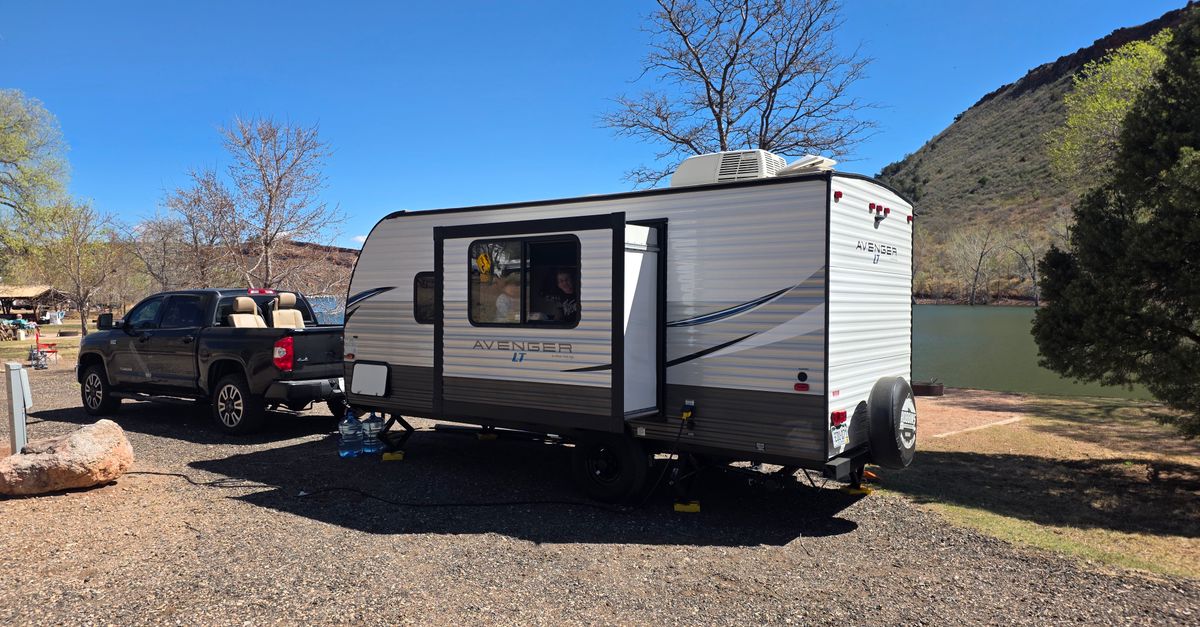
A $20,000 used F-150 rated for 13,000 lbs of towing capacity sounds like a deal until you load your 12,000 lb trailer and discover the truck’s payload limit is only 1,400 lbs — and your trailer’s tongue weight just put you 300 lbs over. The truck might pull it, but you’ve exceeded the payload limit, voided your warranty, and created a dangerous weight distribution that could cause frame damage or brake fade.
Most buyers confuse towing capacity with payload capacity. They’re not the same, and mixing them up is the fastest way to overspend on a truck that can’t safely do the job.
Quick verdict:
- Ford F-150 (2015–2020) is the best choice for frequent towing on a $18,000–$35,000 budget, with 12,500–14,000 lbs towing and proven reliability
- Chevy Silverado 1500 (2017+) is the best choice for diesel fuel economy and max towing (13,400 lbs with 3.0L Duramax), budget $22,000–$40,000
- Ford Ranger or Chevy Colorado are best for light towing (under 7,500 lbs) and lower ownership costs, budget $18,000–$32,000
At a glance
| Truck | Price Range (Used) | Max Towing | Payload | Fuel Economy (EPA) | Best For | Biggest Weakness |
|---|---|---|---|---|---|---|
| Ford F-150 (2015–2020) | $18,000–$35,000 | 12,500–14,000 lbs | 1,400–1,950 lbs | 21 city / 26 hwy (5.0L) | Frequent towing, proven reliability | EcoBoost engines need premium fuel and strict maintenance |
| Chevy Silverado 1500 (2017–2022) | $22,000–$40,000 | 13,400 lbs (diesel) | 2,250 lbs | 22 city / 28 hwy (3.0L diesel) | Max towing + fuel economy | Higher upfront cost for diesel; DPF maintenance ($300–$600 every 80k miles) |
| Ford Ranger (2019–2023) | $20,000–$32,000 | 7,500 lbs | 1,860 lbs | 23 city / 26 hwy | Light towing, parking ease, first-time truck buyers | Half the towing capacity of full-size; tight cab for crews |
| Chevy Colorado (2018–2023) | $18,000–$30,000 | 7,700 lbs (diesel) | 1,550 lbs | 21 city / 26 hwy (diesel) | Diesel longevity, moderate towing | Lower payload than Ranger; fewer used models available |
Prices verified July 2026 via Kelley Blue Book; vary 15–25% by region and mileage.
Payload vs. Towing: Do the Math First
Here’s what the salesperson won’t explain: towing capacity is how much weight you can pull behind the truck. Payload capacity is how much weight you can carry in the bed or cab. Both limits matter, and you can’t exceed either.
The problem: trailer tongue weight (the downward force on the hitch) counts against payload, not towing capacity. If your trailer weighs 12,000 lbs, the tongue weight is typically 10–15% of that — call it 1,500 lbs. That 1,500 lbs eats into your payload limit before you’ve added a single toolbox or passenger.
Worked example:
You’re looking at a 2017 F-150 with a 5.0L engine. Advertised towing: 13,000 lbs. Payload: 1,600 lbs. You plan to tow a 12,000 lb camper.
- Camper weight: 12,000 lbs
- Tongue weight (12%): 1,440 lbs
- Remaining payload for passengers + cargo: 1,600 – 1,440 = 160 lbs
You’ve got 160 lbs left for yourself, a passenger, and any gear in the bed. Two adults and a toolbox put you over. The truck’s rated for 13,000 lbs of towing, but it can’t safely tow this camper unless you strip weight or upgrade to a higher-payload configuration.
Check the driver’s-side door jamb sticker for GVWR (Gross Vehicle Weight Rating) and GCWR (Gross Combined Weight Rating). GCWR is the max total weight of truck + cargo + trailer. Subtract the truck’s curb weight and your payload from GCWR to find your real towing capacity. Manufacturer towing specs assume best-case configuration — often a two-passenger cab with no cargo. NHTSA’s vehicle database has door-jamb specs for verification.
Class 2 vs. Class 3 Trucks: What You’re Buying
Truck “class” isn’t marketing — it’s defined by GVWR, and it determines what the truck can handle.
Class 2 trucks (GVWR under 6,001 lbs):
Ford Ranger, Chevy Colorado, GMC Canyon. Lighter frames, smaller engines (2.3L–2.8L, often turbocharged or diesel). Towing range: 3,500–7,700 lbs. Payload: 1,000–1,860 lbs.
Best for: Towing boats under 6,000 lbs, utility trailers, occasional use. Lower fuel costs (23–26 mpg highway) and easier to park. If you tow once or twice a month and your trailer stays under 7,000 lbs, a Class 2 truck costs less to buy, insure, and fuel.
Weaknesses: Payload limits mean less room for passengers and cargo. Smaller brakes and lighter suspension mean more brake fade and body roll when towing at max capacity. Not recommended for weekly towing or trailers over 7,500 lbs.
Class 3 trucks (GVWR 6,001–10,000 lbs):
Ford F-150, Chevy Silverado 1500, RAM 1500. Heavier frames, larger engines (5.0L–5.3L gas or 3.0L diesel). Towing range: 5,600–14,000 lbs. Payload: 1,400–2,250 lbs.
Best for: Regular towing (weekly or more), RV use, work trucks. Stronger brakes, stiffer suspension, more payload headroom for crews and tools.
Weaknesses: 10–20% higher insurance costs, worse fuel economy (18–22 mpg in real-world towing vs. EPA 26 highway), and higher purchase prices. A used 2017 F-150 at $28,000 costs $1,200–$1,500/year in maintenance vs. $600–$800 for a Ranger.
Budget reality: If you tow frequently, pay for the Class 3 truck. The $6,000–$8,000 premium over a Class 2 is cheaper than replacing a transmission you’ve overworked or dealing with brake fade on a mountain pass.
Ford F-150 (2015–2020) — Best for Frequent Towing
The 2015–2020 F-150 generation offers the best balance of towing capacity, used-market availability, and known reliability. The 5.0L V8 is the sweet spot: proven, naturally aspirated, and bulletproof with basic maintenance. Max towing: 12,500 lbs (up to 14,000 lbs with the 3.5L EcoBoost in certain configurations). Payload: 1,400–1,950 lbs depending on wheelbase and cab size.
Strengths:
- Wide availability in the $18,000–$35,000 used range; easier to find well-maintained examples with service records
- 5.0L engine requires regular-grade fuel and has fewer turbo-related issues than the EcoBoost
- Strong aftermarket support for towing accessories (brake controllers, air bags, fifth-wheel hitches)
Weaknesses:
- EcoBoost engines (2.7L, 3.5L) require premium fuel and are sensitive to maintenance intervals — skipped oil changes lead to carbon buildup and turbo failure ($2,000–$3,000 repair)
- Real-world towing fuel economy: 16–20 mpg highway (not the EPA’s 26 mpg, which assumes no trailer)
- Spark plug issues on older 5.4L models (pre-2015) can cost $800–$1,200 if plugs break during removal
Best for: Buyers towing 8,000–13,000 lbs weekly or more, who want a proven platform with cheap parts and widespread dealer service.
Chevy Silverado 1500 (2017+) — Best for Diesel Fuel Economy

The 2017+ Silverado 1500 fixed the transmission issues that plagued 2014–2016 models. The 3.0L Duramax diesel option offers 13,400 lbs of max towing and better real-world fuel economy (24–28 mpg highway, even when towing). Payload: up to 2,250 lbs in certain configurations.
Strengths:
- Diesel fuel economy pays off if you tow frequently and rack up 15,000+ miles/year
- Highest payload in this comparison (2,250 lbs), leaving more room for tongue weight and cargo
- 2017+ eight-speed transmission is smoother and more reliable than the earlier six-speed
Weaknesses:
- Diesel models cost $4,000–$6,000 more upfront than gas equivalents; fuel savings take 5+ years to break even
- DPF (diesel particulate filter) regeneration required every 80,000 miles; costs $300–$600 if you can’t do it yourself
- Diesel fuel prices are 10–15% higher per gallon than regular gas in most regions
Best for: Buyers who tow year-round, drive long distances, and plan to keep the truck for 8–10 years to recoup the diesel premium.
Ford Ranger (2019–2023) — Best for Light Towing and Lower Costs
The Ranger is a Class 2 truck that tows up to 7,500 lbs with the Max Tow Package. Payload: 1,860 lbs. Powered by a 2.3L EcoBoost four-cylinder. Used prices: $20,000–$32,000 depending on mileage and trim.
Strengths:
- Lowest maintenance costs in this comparison: $600–$800/year for routine service
- Easier to park and maneuver than full-size trucks; better daily-driver option if you tow occasionally
- No major reliability issues reported across the 2019–2023 generation
Weaknesses:
- 7,500 lbs is the ceiling; you can’t upgrade to a heavier trailer without changing trucks
- Crew cab is tight for rear passengers; bed length options are limited (5-foot or 6-foot only)
- Less payload headroom than a Silverado means less margin for error on tongue weight calculations
Best for: First-time truck buyers, hobby haulers (boats under 6,500 lbs, small campers), and anyone who tows less than twice a month.
Chevy Colorado (2018–2023) — Best for Diesel Longevity
The Colorado offers a 2.8L Duramax diesel option that tows up to 7,700 lbs and delivers strong fuel economy (21 city / 26 highway). Payload: 1,550 lbs. Used pricing: $18,000–$30,000.
Strengths:
- Duramax diesel is known for longevity; owners regularly report 200,000+ miles with routine maintenance
- Lower entry price than a Ranger for similar capability
- Z71 off-road package adds locking rear differential and skid plates for mixed-use buyers
Weaknesses:
- Lower payload (1,550 lbs) than the Ranger means tighter margins on tongue weight
- Fewer used models available compared to the Ranger or F-150; regional availability varies
- Diesel option is harder to find on the used market
Best for: Buyers who want Class 2 towing with diesel longevity and plan to keep the truck past 150,000 miles.
Truck Reliability by Generation

Not all model years are equal. Here’s what to watch for:
Ford F-150:
- 2015–2020 (5.0L gas): Reliable; routine maintenance only. Budget $800–$1,200/year.
- 2015–2020 (3.5L EcoBoost): Good if maintained strictly. Turbo carbon buildup is common after 100k miles if oil changes are skipped. Budget $1,200–$1,800/year.
Chevy Silverado 1500:
- 2014–2016: Avoid. Transmission issues (hard shifting, slipping) are common. Repair costs $2,000–$4,000.
- 2017+: Solid. Improved eight-speed transmission. Budget $1,000–$1,500/year.
Ford Ranger:
- 2019–2023: No widespread issues. 2.3L EcoBoost is proven. Budget $600–$800/year.
Chevy Colorado:
- 2018–2023: Diesel models are strong. Gas V6 is reliable but less common. Budget $700–$900/year.
Reliability data sourced from IIHS owner satisfaction surveys and Consumer Reports annual reliability rankings. Real-world costs vary by how hard you tow and how often you service the truck.
Real Ownership Cost Over Five Years
Purchase price is only part of the equation. Here’s what three common scenarios cost over five years, assuming moderate mileage (12,000–15,000 miles/year):
Scenario 1: Light towing (once or twice a month, trailers under 6,000 lbs)
- Ford Ranger (2020, $24,000 purchase): $24,000 + $4,000 maintenance + $9,000 fuel + $4,500 insurance = $41,500
- Ford F-150 5.0L (2018, $26,000 purchase): $26,000 + $6,000 maintenance + $11,000 fuel + $5,500 insurance = $48,500
For light towing, the Ranger saves $7,000 over five years.
Scenario 2: Frequent towing (weekly, trailers 8,000–12,000 lbs)
- Ford F-150 5.0L (2018, $26,000 purchase): $26,000 + $7,500 maintenance + $13,000 fuel + $5,500 insurance = $52,000
- Chevy Silverado 3.0L Duramax (2019, $32,000 purchase): $32,000 + $8,000 maintenance + $10,500 fuel + $6,000 insurance = $56,500
The Silverado diesel costs $4,500 more but delivers better fuel economy and higher payload. Break-even depends on how long you keep it.
Fuel costs assume $3.50/gal for regular gas, $3.85/gal for diesel. Regional prices vary 10–20%.
Budget Truck Myths
Myth: “Older full-size trucks are always cheaper than new mid-size trucks.”
False. A 2015 F-150 at $20,000 with 120,000 miles may cost $1,500/year in maintenance vs. $700/year for a 2020 Ranger at $24,000 with 40,000 miles. Over five years, total cost of ownership can flip.
Myth: “All used trucks of the same year cost the same.”
False. Transmission service history, regional demand, and trim options create 20–30% price swings. A 2018 Silverado with documented transmission fluid changes is worth $3,000–$5,000 more than one without service records.
Myth: “Towing capacity is all that matters.”
False. Payload, GCWR, and brake capacity matter equally. Exceeding any one limit is unsafe and voids your warranty.
When to See a Pro
Before buying any used truck for towing:
- Get a pre-purchase inspection focused on transmission fluid condition, brake wear, and frame rust. Cost: $100–$200. Worth every dollar.
- Have a mechanic check for signs of hard towing use: worn transmission mounts, cracked exhaust manifolds, brake pad thickness under 4mm.
- If the truck has over 100,000 miles, budget for a transmission fluid change ($150–$250) and coolant flush ($100–$150) within the first 6 months.
Critical safety note: Never exceed the payload or GVWR limits shown on the driver’s door jamb. Overloading causes frame cracks, brake fade, and loss of steering control. If you’re not sure how to calculate GCWR or tongue weight, ask a mechanic or towing-equipment specialist before you hitch up.
General information, not professional mechanical or financial advice. Towing capacities and costs vary by truck configuration, model year, and region. Always verify specs on the door-jamb sticker and consult your owner’s manual before towing. For additional guidance on evaluating used trucks, see Used Car History Report: What to Check Before You Buy and Certified Pre-Owned Cars Worth Buying: What You Actually Get.