

Skip tire rotation and you’re walking away from 10,000–15,000 miles of usable tread life. On a front-wheel-drive car, the front tires wear down to replacement depth (2/32”) around 40,000–50,000 miles, while the rears can hit 80,000–100,000 miles without breaking a sweat. Rotation spreads that load across all four corners — same rubber, twice the mileage.
The short answer
Rotate your tires every 5,000–8,000 miles or every 6 months, whichever comes first. Front tires on front-wheel-drive vehicles carry engine weight, steering load, and all the drive torque — they wear faster by design. Rotation keeps the wear rate even and prevents you from replacing two tires at 45,000 miles and sitting on two unused rears.
The rotation interval breakdown
The 5,000–8,000-mile window comes from Michelin, Goodyear, Bridgestone, and the Tire Industry Association. Performance tire brands tighten it to 3,000–5,000 miles; if you’re running summer or track-capable rubber, check your owner’s manual.
Low-mileage drivers (under 5,000 miles a year) should rotate every 6–12 months regardless of odometer. Tires sitting stationary develop flat spots and lose pressure, especially in cold weather — the calendar matters as much as road contact.
What pushes the interval shorter:
- Aggressive driving (hard acceleration, heavy cornering, frequent towing)
- Bad roads (potholes, gravel, construction zones)
- Underinflation by even 2–3 PSI
- Heavy cargo or consistent passenger loading on one side
Defensive drivers on good pavement can stretch toward 8,000 miles. If you’re towing a trailer every weekend or commuting on stop-and-go surface streets, aim closer to 5,000.
Which rotation pattern to use
The pattern depends on your drivetrain, not the shop’s convenience. Use the wrong one and you’re moving the problem instead of solving it.
| Drivetrain | Pattern | Why |
|---|---|---|
| Front-Wheel Drive (FWD) | Cross (X-pattern) | Front tires wear faster; cross rotation moves rears to front on opposite sides to balance wear acceleration |
| Rear-Wheel Drive (RWD) | Straight (front-to-rear) | Rear tires wear faster; fronts move straight back, rears move straight forward |
| All-Wheel Drive (AWD) | Check owner’s manual first | Torque distribution varies by system; wrong pattern can stress the transfer case |
| Truck (2WD/4WD) | Straight or cross | Depends on drive wheels and load; 4WD trucks usually straight-rotate; check manual |
X-pattern (FWD): Front-right goes to rear-left. Front-left goes to rear-right. Rear-left goes to front-right. Rear-right goes to front-left.
Straight pattern (RWD): Front-left goes to rear-left. Front-right goes to rear-right. Rear-left goes to front-left. Rear-right goes to front-right.
AWD rotation: why you can’t guess
AWD is not one system. Most Subaru symmetrical-AWD setups require cross-rotation. Many Audi and Lexus AWD systems default to straight rotation. Some BMW AWD configurations restrict rotation entirely and monitor individual wheel speed to detect wear imbalance — cross them and you trigger a drivetrain fault.
Your manual will specify the pattern. If it doesn’t, call the parts department with your VIN — they’ll know.
The directional and asymmetrical tire constraint

Directional tires have tread designed to roll in one direction — you’ll see an arrow on the sidewall pointing forward. These can only rotate front-to-rear on the same side. Front-left stays on the left side, moves to rear-left. Cross them and you’re running the tread backward, which voids the warranty and reverses water channeling.
Asymmetrical tires have an inside and outside tread face (sidewall will say “OUTSIDE” or “THIS SIDE OUT”). Most can use a cross pattern as long as you keep the marked side facing out. If the tire is also directional, you’re locked into same-side rotation.
Check your sidewalls before you start. Arrow or “outside” marking means the standard pattern doesn’t apply. Violating these constraints is a safety issue and kills the warranty.
The 10-year retirement rule nobody mentions
Here’s the part most rotation guides skip: tires must be replaced 10 years from the manufacture date regardless of tread depth. Rubber degrades over time even if the tire never touches pavement. UV exposure, temperature cycling, and ozone break down the compound — the tire can look fine and still fail structurally.
The manufacture date is stamped on the sidewall as a DOT code. The last four digits are the week and year (e.g., “2318” means the 23rd week of 2018). If you bought a car in 2020 and the tires say 2016, you’re halfway to retirement before you drive a mile. NHTSA tire safety guidance flags this as a hard limit — check it when you rotate.
Low-mileage drivers hit the age limit before the tread limit. If you’re rotating on schedule but only driving 3,000 miles a year, the calendar retires the tire, not the wear.
The cost-benefit math
Rotation service runs $30–$80 per visit depending on shop and region. Some tire dealers include free rotation if you bought the tires there; oil-change chains sometimes bundle it.
Skipping rotation costs more. Without rotation, front tires on a FWD car reach 2/32” tread depth around 40,000–50,000 miles while the rears still have 6/32”–8/32” left. You replace the fronts, then drive another 30,000–40,000 miles and replace the rears — two separate purchases instead of one full set at 60,000–65,000 miles. Over the vehicle’s life, rotating on schedule saves $300–$600 in premature replacement cost.
The other cost is safety. Worn front tires on a front-wheel-drive car increase stopping distance on wet pavement, especially once tread depth drops below 4/32”. NHTSA makes it clear: even grip across all four wheels matters for stability under braking and in turns. Flat-spotted rear tires can bulge and fail suddenly.
You’re not paying $40 for the shop’s time. You’re buying 10,000 more miles and a safety margin.
What rotation does not fix
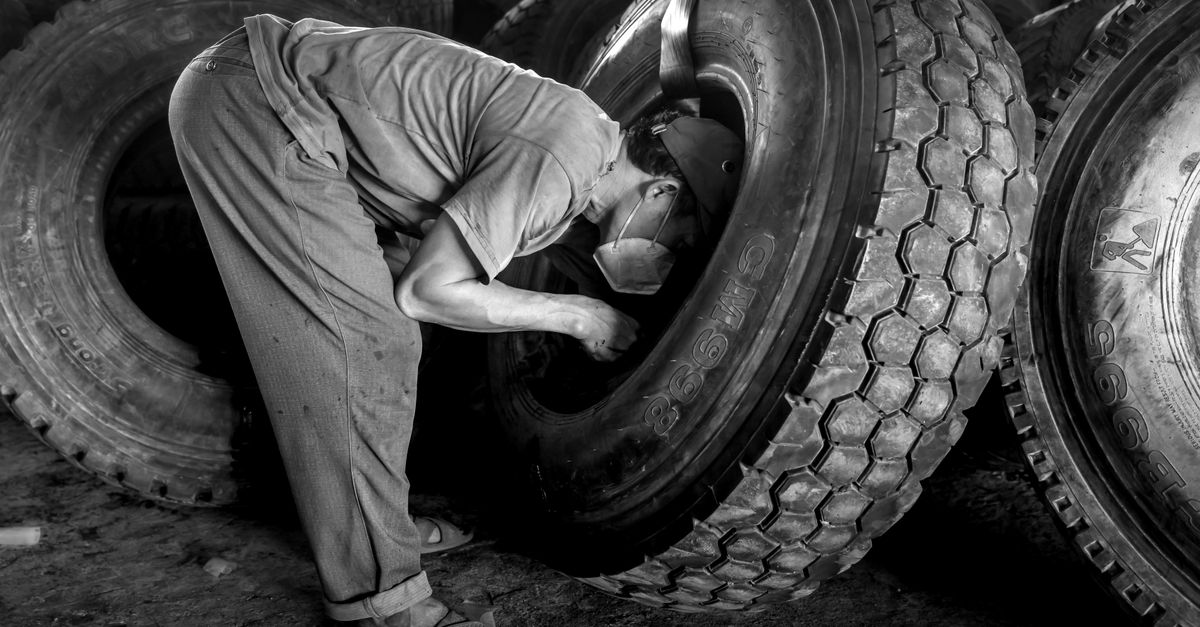
Rotation distributes wear; it doesn’t correct the cause of uneven wear. If your tires are wearing on one edge or showing cupping, rotation will just spread that damage around. The underlying problem is usually alignment, underinflation, or suspension wear.
If you rotate and the pulling or vibration doesn’t improve, check Wheel Alignment Check: When You Need It and What It Costs next. Alignment is the prerequisite — rotation is the maintenance layer on top of it.
Edge cases worth knowing
Full-size spare: If your spare is the same size as your road tires (not a temporary donut), rotate it into the set. This keeps all five tires wearing evenly and gives you a usable spare when you need it. Temporary spares don’t rotate in.
Run-flat tires: These can be rotated, but some manufacturers restrict the pattern. Check your owner’s manual — some run-flats forbid cross-rotation.
Staggered setups: Performance cars with different-size tires front and rear can’t rotate. You’re replacing fronts and rears on separate schedules.
Seasonal tire changes: If you swap to winter tires every year, treat the changeover as a rotation opportunity. When you pull the summers off in November, note which corner each came from and reinstall them on different positions in the spring.
Common rotation questions
How do I know if my tires need rotation?
Visible uneven wear — outer edge worn more than center, or one tire’s tread noticeably shallower than the others. If tread depth variance between wheels exceeds 2/32”, you’ve waited too long. Steering vibration or pulling can also signal uneven wear, though that’s more often an alignment issue. Check how to check your tire tread depth to measure accurately.
Can I rotate tires myself?
Yes, if you have a jack, jack stands rated for your vehicle’s weight, and know the correct pattern for your drivetrain. The safety risks are real: wheel runaway if the jack slips, crushing hazard if the stands fail, and lug-nut torque specs matter (under-torque and the wheel comes loose; over-torque and you strip the studs). If you’re not confident in the setup, pay the $40.
Does rotation affect wheel balancing?
No. Balancing corrects weight distribution on each wheel-tire assembly; rotation just moves those assemblies to different corners. That said, rotation is a good time to check balance if you’re noticing vibration — you’ve already got the wheels off.
Do I still rotate if I just replaced two tires?
Yes, but the pattern changes. New tires go on the rear axle regardless of drivetrain — this is a safety standard because rear blowouts are harder to control than fronts. Then rotate all four on the normal schedule going forward to even out the wear.
Rotation is the easiest maintenance win you’ll get. The interval is simple, the cost is low, and the payoff shows up in your mileage log and your wallet. Follow the pattern for your drivetrain, watch for directional markings, check the manufacture date while you’re under there, and don’t skip it just because the tires look fine. Uneven wear doesn’t announce itself until it’s already costing you money.
This article provides general automotive maintenance information and is not professional mechanical advice. Tire service involves vehicle lifting and wheel removal; if you’re unsure of the procedure or your equipment, consult a qualified technician.