
A transmission that slips during your test drive will cost you $1,500–$3,500 to rebuild. Frame rust you didn’t spot means the car isn’t safe to drive, period. Most used-car inspection guides give you a generic list — tires, fluids, lights — but they don’t tell you why each check matters or what the repair will cost when you find a problem.
This is the inspection system I use when a friend asks me to look at a car they’re considering. It’s organized as a sequence — exterior walk-around first, then under the hood, then the test drive, then records review — because the order matters. If you find transmission hesitation on the test drive, you stop there and either negotiate hard or walk away. You don’t waste time checking the AC after that.
This checklist catches most major problems. For vehicles over eight years old or with more than 100,000 miles, budget $150–$400 for a professional pre-purchase inspection (PPI) by an ASE-certified mechanic — the cost is insurance against a $2,000+ surprise repair.
What you’ll need
Tools:
- Flashlight (headlamp works better; keeps your hands free)
- Tire tread depth gauge or penny
- OBD-II code reader (borrow one or get a free scan at AutoZone/Advance Auto)
- Paint depth gauge (optional; borrow from a body shop if checking for accident history)
- Notebook and phone camera
Materials:
- Clean rag or paper towels (to check fluids)
- CARFAX or AutoCheck report (get the VIN from the seller; costs ~$40 or sometimes free from the dealer)
Prerequisites:
- Valid driver’s license
- Proof of insurance (most sellers require this before a test drive)
- Daylight or very good lighting (never inspect a car at night or in dim garage lighting)
Before you start
Safety first: You’re evaluating whether this car is mechanically sound and safe to drive. Do not skip the brake, steering, or suspension checks — failures in these systems cause crashes. If you find anything that compromises braking or steering, do not buy the car without a professional safety inspection, even if the seller offers a steep discount.
Bring a second person if possible. One person drives, the other listens for noises and watches the instrument panel. On a solo inspection, drive a quiet route so you can hear abnormal sounds.
Cold start: Arrange to see the car first thing in the morning after it’s sat at least three hours. A cold start reveals problems a warm engine hides (rough idle, starting hesitation, smoke).
Phase 1: The exterior and interior walk-around
Start outside the car with the engine off. You’re looking for accident history, rust, wear patterns, and whether the odometer matches the condition.
Exterior body and paint
Walk around the car slowly. Look for:
- Panel gaps: Doors, hood, trunk, and fenders should have uniform gaps of 3–5mm. Gaps wider than 5mm or uneven spacing means prior collision repair or poor-quality bodywork.
- Paint color match: Sight down the body panels in good light. Mismatched color, overspray on trim or rubber seals, or texture differences indicate repainting after an accident.
- Rust: Surface rust (light orange dusting) is cosmetic in dry climates but a warning sign in snow-belt states. Scale rust (flaking, bubbling paint) spreads and costs $200–$1,000+ to repair. Structural rust — holes in the frame, rocker panels, or floor pan — is a walk-away; you cannot safely repair frame rust.
If you’re in the Midwest or Northeast, get under the car (Phase 4) and check the frame. Rust kills cars early in salt states.
Tires
Check all four tires, including the spare:
- Tread depth: Insert a penny into the tread groove with Lincoln’s head upside down. If you can see the top of his head, the tire is below 4/32″ and due for replacement soon. Four new tires cost $400–$800 depending on size. Use this as a negotiation point.
- Uneven wear: Bald edges or center wear indicates alignment problems ($75–$200 to fix) or chronic under-inflation, suggesting neglected maintenance. Cupping or scalloped wear means worn suspension components ($400–$800 for struts or shocks).
- Age: Check the DOT date code on the sidewall (four-digit week/year, e.g., “2318” = 23rd week of 2018). Tires older than six years harden and lose grip even if tread looks fine.
Interior condition and odor
Open all doors and sit in the driver’s seat. Check:
- Wear patterns: Steering wheel, pedals, seats, and shifter wear should match the odometer. A steering wheel worn through the coating at 40,000 miles suggests odometer tampering. Excessive wear at low mileage is a red flag.
- Smell: The interior should smell clean or neutral. A musty, moldy, or mildew odor indicates water intrusion — possibly flood damage — or failed AC drainage ($200–$1,500 to remediate mold and fix the AC). Walk away from flood-damaged cars; electrical gremlins appear months later and cost $500–$2,000+.
- Functionality test: Test every switch, button, and control. Windows (all four), door locks, seat adjustments, mirrors, climate controls, wipers, headlights, turn signals, hazards, radio, and infotainment. Each failed component costs $50–$300 to repair.
- Warning lights: Turn the key to the “on” position without starting the engine. All warning lights should illuminate briefly, then go out when you start the car. If a light stays on — especially check engine, ABS, airbag, or oil pressure — note it. We’ll scan for codes later.
Trunk and cargo area
Pop the trunk. Look for:
- Spare tire, jack, and tools: Missing equipment isn’t a deal-breaker, but it’s a negotiation point ($100–$200 to replace).
- Water stains or rust: Staining in the trunk or spare tire well indicates a leaking trunk seal or prior flood damage.
- Accident evidence: New or mismatched undercoating, fresh welds, or buckled floor pan indicates rear-end collision repair. Cross-check with the CARFAX.
Phase 2: Under the hood
Pop the hood with the engine cold (off for at least two hours). You’re checking fluid condition, leaks, and component wear.
Fluid levels and condition
Check these fluids with the car parked on level ground:
- Engine oil: Pull the dipstick, wipe it clean, reinsert, then pull again. Oil should be amber to light brown and at the “full” mark. Black oil isn’t a failure — that’s normal after 3,000+ miles — but it tells you the oil change is overdue. If the level is low (below the “add” mark), the engine may burn oil or have a leak. Overfilled oil can indicate an amateur oil change or an attempt to hide a leak.
- Coolant: Check the overflow reservoir (translucent plastic tank near the radiator). Fluid should be bright green, pink, or orange — not rusty, cloudy, or oily. Rusty coolant means corrosion inside the radiator or engine ($300–$1,500 to flush and repair). Oily coolant indicates a head gasket leak ($1,200–$2,500 repair).
- Brake fluid: Small reservoir near the firewall, usually marked with a brake symbol. Fluid should be light amber and at the “max” line. Dark or black fluid is old (overdue for flush, $100–$150). Milky or cloudy fluid means moisture contamination — a brake safety issue. Get this inspected by a professional before purchase.
- Power steering fluid: Should be light amber or red, not dark or burnt-smelling. Low fluid or dark color suggests a leak or old fluid ($100–$300 to repair leaks).
- Transmission fluid (if dipstick is accessible): Many modern automatics have sealed transmissions with no dipstick. If there is a dipstick, fluid should be bright red and smell sweet or neutral. Dark brown or burnt-smelling fluid indicates transmission stress or overheating. This is the most expensive repair on a used car — $1,500–$3,500 to rebuild — so if the fluid is burnt, walk away or negotiate a steep discount after getting a transmission diagnostic ($100–$150).
Belts, hoses, and battery
- Serpentine belt: Look for cracks, fraying, glazing (shiny surface), or missing chunks. Belts typically last 60,000–100,000 miles. Replacement costs $75–$200. A worn belt isn’t a deal-breaker, but factor the cost into your offer.
- Hoses: Squeeze the radiator and heater hoses (near the engine and radiator). They should feel firm but pliable. Soft, mushy, or cracked hoses are near failure and cost $100–$300 to replace.
- Battery: Check the terminals for corrosion (white or green crust). Light corrosion is normal and easy to clean ($10–$50). Heavy corrosion or a battery older than 4–5 years (check the date sticker) means replacement soon ($100–$200).
Signs of leaks
Look under the engine and transmission for fresh fluid:
- Oil leaks: Small seeps from valve covers or the oil pan gasket are common on older engines and cost $200–$600 to fix. A large puddle or active drip is a bigger concern.
- Coolant leaks: Green or pink stains around the water pump, radiator, or hoses indicate leaks ($300–$800 to repair).
- Transmission or differential fluid: Red or brown fluid under the center or rear of the car. Transmission leaks can be minor (pan gasket, $150–$300) or major (seal failure, $500–$2,000+).
If you see any fresh puddle, ask the seller to explain. If they don’t know or dismiss it, get a PPI before buying.
Phase 3: The test drive

This is where you’ll find the expensive problems: transmission, brakes, steering, and suspension. Plan a 15–20 minute route with varied conditions — city streets (stop-and-go), a highway on-ramp (acceleration and sustained speed), and a quiet residential street (to listen for noise).
Before you start the engine
- Cold start: Turn the key and listen. The engine should turn over in 1–2 seconds and settle into a smooth idle. Rough idle, stalling, or excessive cranking indicates ignition, fuel, or battery problems ($50–$800 depending on cause).
- Scan for codes: Plug in your OBD-II reader and check for stored or pending codes. Active codes (especially powertrain codes like P0300, P0420, or transmission codes) are red flags. Research the codes online; some are minor ($50–$200 sensors), others predict major failure ($1,000+).
Driving feel: engine and transmission
Acceleration:
- From a stop, the car should accelerate smoothly without hesitation, surging, or jerking. Hesitation under load can mean fuel delivery issues, ignition problems, or transmission wear ($200–$2,000+ depending on cause).
- Highway merge: Accelerate from 40 to 65 mph. The engine should respond immediately, and the transmission should downshift smoothly without delay or hard jolts.
Transmission shifts (automatic):
- Shifts should be nearly imperceptible. Count the shifts as you accelerate from 0 to 50 mph (usually 3–4 shifts depending on the transmission). Delayed shifts, hard clunks, or slipping (engine revs but the car doesn’t accelerate) are transmission failure warning signs. This is a walk-away issue unless you’re prepared to negotiate $1,500–$3,500 off the price and budget for a rebuild immediately.
Manual transmission (if applicable):
- Clutch should engage smoothly in the middle third of pedal travel, not at the very top (worn) or very bottom (adjustment issue).
- Test a hill start: the car should hold without rolling back excessively. Clutch slip (engine revs but car doesn’t move) means imminent clutch replacement ($800–$1,500).
Braking
First stop from 20 mph:
- Pedal should feel firm and responsive. Spongy or soft pedal indicates air in the brake lines or worn components. Do not drive or buy this car without a professional brake inspection.
- The car should stop in a straight line without pulling left or right. Pulling indicates uneven brake wear, a stuck caliper, or suspension problems ($200–$800). Get a professional diagnosis.
Hard stop (safe conditions):
- Find an empty road or parking lot. Accelerate to 30–40 mph and brake hard (but not to the point of ABS activation unless testing ABS). Listen and feel for:
- Grinding or squealing: Metal-on-metal noise means pads are worn to the backing plate. You’re looking at $400–$800 to replace pads and rotors on both axles.
- Pulsation or vibration: Warped rotors. Replacement costs $300–$700.
- Brake fade: Pedal travel increases or braking weakens with repeated stops. This indicates contaminated pads, boiling fluid, or worn components. Do not buy this car without a professional brake inspection.
Steering and suspension
Low-speed steering:
- Turn the wheel lock-to-lock while parked or moving slowly (parking lot). Steering should be light and responsive, with no binding, clunks, or grinding. Noise or resistance indicates power steering problems ($300–$800) or steering rack wear ($500–$1,200). Get a professional steering inspection before purchase.
Highway tracking:
- At 50–60 mph on a straight, flat road, briefly release the steering wheel (safe conditions only). The car should track straight or drift gently. Hard pulling to one side indicates alignment issues ($75–$200) or uneven tire wear. Severe pulling can mean suspension damage or frame misalignment from a prior accident. Get a professional suspension and alignment diagnosis.
Bumps and rough roads:
- Drive over speed bumps, potholes, and rough pavement at moderate speed. Listen for:
- Clunks or banging: Worn struts or shocks ($400–$800 per axle), control arms ($200–$400), or sway bar links ($100–$250). Have a mechanic inspect before purchase.
- Rattling or scraping: Loose exhaust, heat shields, or undercarriage damage. Usually minor ($50–$300) but could indicate prior damage.
Excessive bouncing or body roll after a bump means worn suspension. Have a professional assess the cost and safety.
Climate and electrical systems
AC and heat:
- Turn the AC to max cold. It should blow cold air within 30–60 seconds. Mildly cool air indicates low refrigerant (recharge costs $150–$400 but may indicate a leak). Warm air only means compressor failure ($800–$1,200).
- Heat should blow hot within one minute. Weak heat suggests low coolant, a clogged heater core, or thermostat failure ($200–$600).
Defroster:
- Critical in winter climates. Turn on the defroster; it should clear a fogged windshield in under two minutes.
Wipers and lights:
- Test wipers on a wet windshield or use washer fluid. Blades should clear without chattering or streaking. Blades are $15–$30; a failed motor is $300–$600.
- Verify all exterior lights work: headlights (low and high beam), brake lights, turn signals, reverse lights, and hazards. Bulbs cost $10–$50; a failed module costs $100–$400.
Phase 4: Undercarriage and exhaust (if possible)
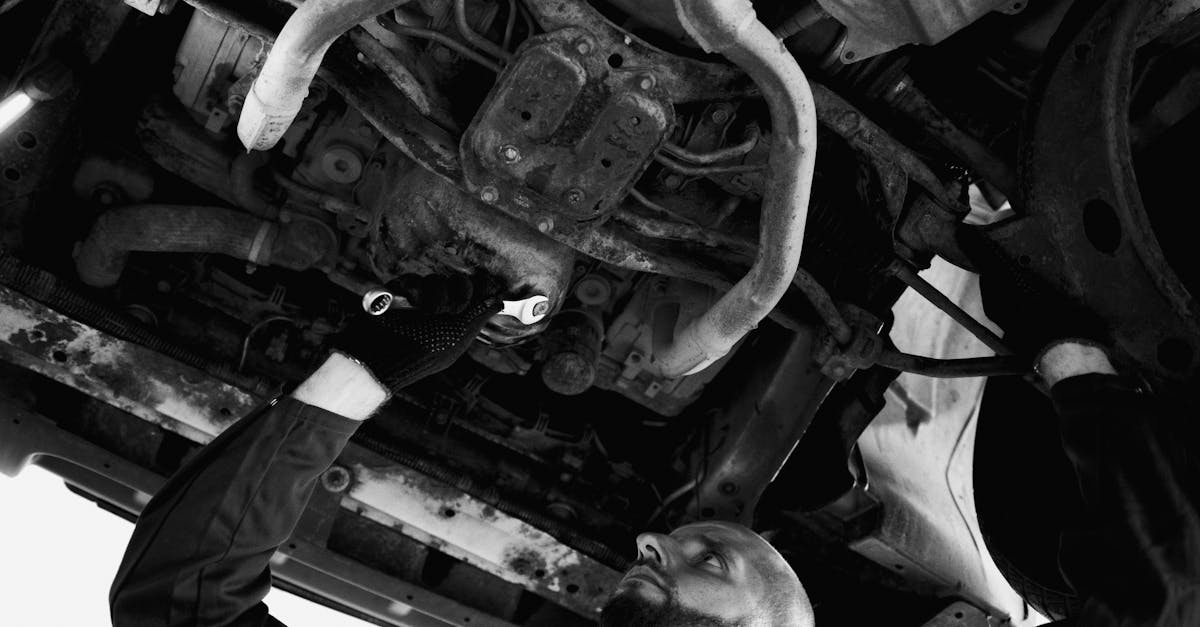
If the seller allows or you can get the car on a lift (some inspection shops offer free lift time if you’re a customer), check the underside.
What to look for:
- Frame and subframe: No rust holes, cracks, or welded repairs. Surface rust is cosmetic; rust that flakes or crumbles when you poke it is structural. Frame rust is a walk-away — the car is not safe.
- Exhaust system: Should be intact from engine to tailpipe with no holes or dragging sections. Rust holes in the muffler or pipe cost $200–$800 to replace and will cause the car to fail emissions testing in most states.
- Fluid leaks: Look for wet spots or drips at the engine oil pan, transmission, differential, and brake lines. Fresh leaks (wet, not just staining) need diagnosis ($100–$150) and repair ($200–$2,000+ depending on source).
- Suspension components: Control arms, tie rods, ball joints, and CV axles should have no tears, play, or grease leaks. Any play or damage is a safety issue. Have a mechanic inspect before purchase.
If you can’t get under the car, at least look for leaks on the ground where it’s been parked.
Phase 5: Review records and vehicle history
Before you make an offer, review the documentation.
Service records
Ask the seller for maintenance records: oil changes, major services (timing belt, transmission service, coolant flush), and repair invoices.
What you’re looking for:
- Consistent maintenance: Oil changes every 5,000–7,500 miles (or per manufacturer spec). Regular service = lower risk.
- Gaps or missing records: No service history for 12+ months or missing records at high-mileage intervals (60K, 90K, 120K) suggests deferred maintenance. Budget for catch-up service ($500–$1,500+).
- Mileage validation: Compare odometer readings on service invoices to the current odometer. Jumps backward or large gaps indicate possible odometer rollback (illegal; grounds for rescinding the sale in most states).
CARFAX or AutoCheck report
Run a vehicle history report using the VIN. These reports are useful but not comprehensive—they catch many reported accidents and title issues, but private repairs and some minor collisions may not appear.
Red flags in the report:
- Salvage, rebuilt, or flood title: The car was totaled by an insurance company. Structural or water damage. Residual value is 30–50% of a clean-title equivalent. Only buy if you’re getting a steep discount and a professional inspection confirms it’s safe.
- Multiple owners in a short time: Three or more owners in five years suggests recurring problems or a distressed sale.
- Mileage inconsistencies: Odometer readings that jump backward or show large gaps between records. This indicates tampering.
- Accident history: Reported accidents aren’t automatically disqualifying, but cross-check with your paint and body inspection (Phase 1). A “minor” accident that required frame repair is a bigger deal than the report implies.
If the CARFAX is clean but you found paint mismatches or panel gaps during your inspection, the car was likely in an unreported accident. Get a professional opinion.
Red flags: When to walk away

Some issues are negotiable. Others mean you walk away, period.
Always walk away if you find:
- Active check engine light with codes indicating transmission, engine, or emissions failure (unless you’re buying it as-is with a matching discount).
- Transmission hesitation, slipping, clunking, or delayed shifts during the test drive. Transmission failure costs $1,500–$3,500 to fix.
- Frame rust, holes, or structural corrosion. Not repairable and not safe.
- Flood damage evidence: Mud or water stains in door seals, under the carpet, or in the trunk; musty smell; corrosion under the dashboard. Electrical failures appear months later and cost $500–$2,000+.
- Salvage or rebuilt title without full disclosure and a steep discount (40–50% off comparable clean-title cars).
- Brake pedal goes to the floor or feels spongy. Brake failure risk.
- Steering play greater than 1 inch at the rim or hard pulling to one side. Alignment costs $75–$200; suspension damage costs $400–$1,000+.
- Mismatched VIN, odometer rollback evidence, or title discrepancies. Legal and safety issue.
- Multiple warning lights active that the seller cannot explain.
- Major fluid leaks (transmission, coolant, oil) with fresh puddles under the car.
Yellow flags — negotiate or get a PPI:
- Worn tires near replacement (negotiate $400–$800 off)
- Cosmetic wear on interior or paint (normal for age; cost out refurbishment if buying from a dealer)
- Minor oil seeps or residue (monitor, not immediate failure)
- Odometer over 100,000 miles without service records (get a PPI to assess engine and transmission health, $150–$400)
- Single-owner car with long gaps between oil changes (risk of engine sludge or cooling system neglect)
When to hire a professional pre-purchase inspection
I recommend a PPI for any car that’s:
- Eight or more years old
- Over 100,000 miles
- Priced above $15,000 (the risk of a $2,000+ hidden repair justifies the $150–$400 inspection fee)
- Missing service records or has a history you can’t verify
- Shows yellow flags from your inspection (transmission concerns, undercarriage rust, electrical issues)
An ASE-certified mechanic will put the car on a lift, scan all systems, test-drive it, and give you a written report with repair cost estimates. Use that report to negotiate or walk away. A thorough PPI is comprehensive and costs $150–$400 depending on your region. It’s the best money you’ll spend.
Where to get a PPI:
- Independent ASE-certified shops (not a chain; you want a mechanic who has no stake in the sale)
- Mobile pre-purchase inspection services (they come to the car)
- Dealership service departments for the same brand (more expensive, $300–$400, but they know common failure modes for that make)
Do not use a shop recommended by the seller. Find your own mechanic.
Negotiating based on what you found
Once you’ve completed the inspection, you have leverage. Quantify every defect against real repair costs and use that to justify your offer.
Example:
- Worn tires (4/32″ tread remaining): $600 to replace all four
- Brake pulsation noted during test drive: $500 for rotors and pads (get a quote)
- Minor oil seep from valve cover: $300 to replace gasket
- Total: $1,400 in immediate or near-term repairs
Offer $1,200–$1,400 below asking price (or whatever the market and seller’s timeline allow). If they won’t negotiate and the defects are significant, walk away. There are other cars.
For major issues (transmission problems, frame rust, flood damage), either walk away or negotiate a discount that reflects the full repair cost plus your risk — typically 40–60% off a comparable clean car.
FAQ
Should I get a pre-purchase inspection even if the car seems fine?
Yes, if the car is over eight years old or has more than 100,000 miles. You can catch most problems with this checklist, but a professional inspection on a lift catches issues you can’t see from the ground — early transmission wear, exhaust leaks, or suspension components. Cost is $150–$400; compare that to a $2,000+ surprise repair six months later.
Can I trust a clean CARFAX report?
CARFAX and AutoCheck are useful but not comprehensive. They catch many reported accidents and title issues, but private repairs and some minor collisions won’t show up. Always cross-check the report with your physical inspection — paint mismatches, panel gaps, and undercarriage rust tell the real story.
What if the seller won’t let me get a pre-purchase inspection?
Walk away. A seller who refuses a PPI is hiding something. Legitimate private sellers and dealerships expect informed buyers to get an inspection. If they push back, it’s a red flag.
How much can I negotiate based on inspection findings?
Quantify each defect with a repair quote. For minor issues (worn tires, brake pads, belts), you can typically negotiate 70–90% of the repair cost off the asking price. For major issues (transmission, suspension, frame damage), either walk away or negotiate the full repair cost plus a risk premium — often 40–60% off a comparable clean vehicle. Your leverage depends on the market, how long the car’s been listed, and whether the seller is motivated.
Use this checklist on any used car before you hand over money. Budget 45–60 minutes for the full inspection, or hire a professional for $150–$400 if the car is high-mileage or you’re not confident diagnosing mechanical issues yourself. The time and cost are insurance against expensive surprises — a $3,000 transmission repair, frame rust that makes the car unsafe, or flood damage that shows up as electrical gremlins months later.
This is general information based on common automotive service standards and repair costs as of 2026. It is not professional mechanical or financial advice. Repair costs vary by region, vehicle make/model, and shop rates. Always have safety-critical systems (brakes, steering, suspension) inspected by an ASE-certified mechanic before purchase.